
Trickle at the kitchen faucet. Shower that barely rinses shampoo out. A water bill creeping up for no obvious reason. Low water pressure causes range from a half-closed shutoff valve to corroded galvanized pipe that has been quietly narrowing since the 1980s, and The Colony's hard NTMWD water accelerates nearly every one of them.
Aqua Pure Plumbing works out of 1671 Riverview Dr right here in The Colony, and lead plumber Devan has diagnosed these exact patterns across the area for years. We can usually tell you which cause is behind your problem before we ever touch a wrench. Weak pressure driving you crazy? We diagnose the cause the same day.
Weak pressure driving you crazy? We diagnose the cause the same day.
Key Takeaways
- The most frequent culprits in The Colony include corroded galvanized pipes, failing pressure regulators, and calcium scale buildup from hard NTMWD water.
- Homes built in the late 1970s through early 1990s in neighborhoods like Stewart Creek Estates may still have original supply lines that restrict flow.
- A half-closed house shutoff valve or meter valve is the easiest fix, and it takes two minutes to check before calling anyone.
- If pressure drops only at one fixture, the problem is local. If it is whole-house, start at the regulator or the main line.
- Chloramine disinfection used by NTMWD is harder on copper pipe interiors than free chlorine, speeding up pitting and scale from the inside out.
What Causes Low Water Pressure in The Colony Homes?
Most weak-pressure calls in The Colony trace back to eight specific culprits, and our crew diagnoses these problems across the DFW area every week. Generic guides miss what makes this area different: Blackland Prairie clay heaving against buried supply lines, aging galvanized pipe in neighborhoods along the Stewart Creek corridor, and NTMWD chloramine chewing on copper from the inside.
Some fixes you can handle yourself. Others, like a slab leak hiding under your foundation, carry a flooring and mold bill that dwarfs the plumbing repair if you wait. That is where professional leak detection pays for itself fast.
Why The Colony Homes Are Especially Prone to Pressure Problems
Older subdivisions. Aggressive water chemistry. Soil that never stops moving. Those three things combine here in ways that accelerate pressure loss faster than most DFW cities see.
Clay Soil Movement and Buried Supply Line Stress
The Colony sits on USDA expansive clay series soils, the same Blackland Prairie clay that runs across North Texas. That clay swells when it rains and shrinks hard in a dry summer. Buried copper and galvanized lines flex with every cycle. Over decades, joints separate and micro-fractures open up, well before water ever reaches your meter.
Neighborhoods along the Stewart Creek corridor carry some of the longest residential pipe runs in the area. Those lines were installed in the late 1970s through early 1990s and have absorbed thirty-plus years of seasonal soil movement. A professional leak detection inspection often finds stress fractures here that homeowners never suspected.
Hard Water Scale and Pipe Age by Subdivision
Water delivered through the North Texas Municipal Water District uses chloramine disinfection, chlorine combined with ammonia. Free chlorine is hard enough on copper. Chloramine is more aggressive, eroding Type M copper pipe interiors progressively over time. Older Plum Creek and Windhaven properties with original galvanized steel or early copper supply lines feel this the most.
NTMWD water also carries elevated hardness levels. Calcium and magnesium carbonate deposits build up inside pipes and fixtures, narrowing the bore by 30 to 40 percent before you notice any drop in flow. That scale is also why hydro jetting sometimes restores pressure that a simple fixture swap never will. Corroded pipes and low pressure go hand in hand in subdivisions this age.
Cause 1: Is Your Pressure Regulator Failing?
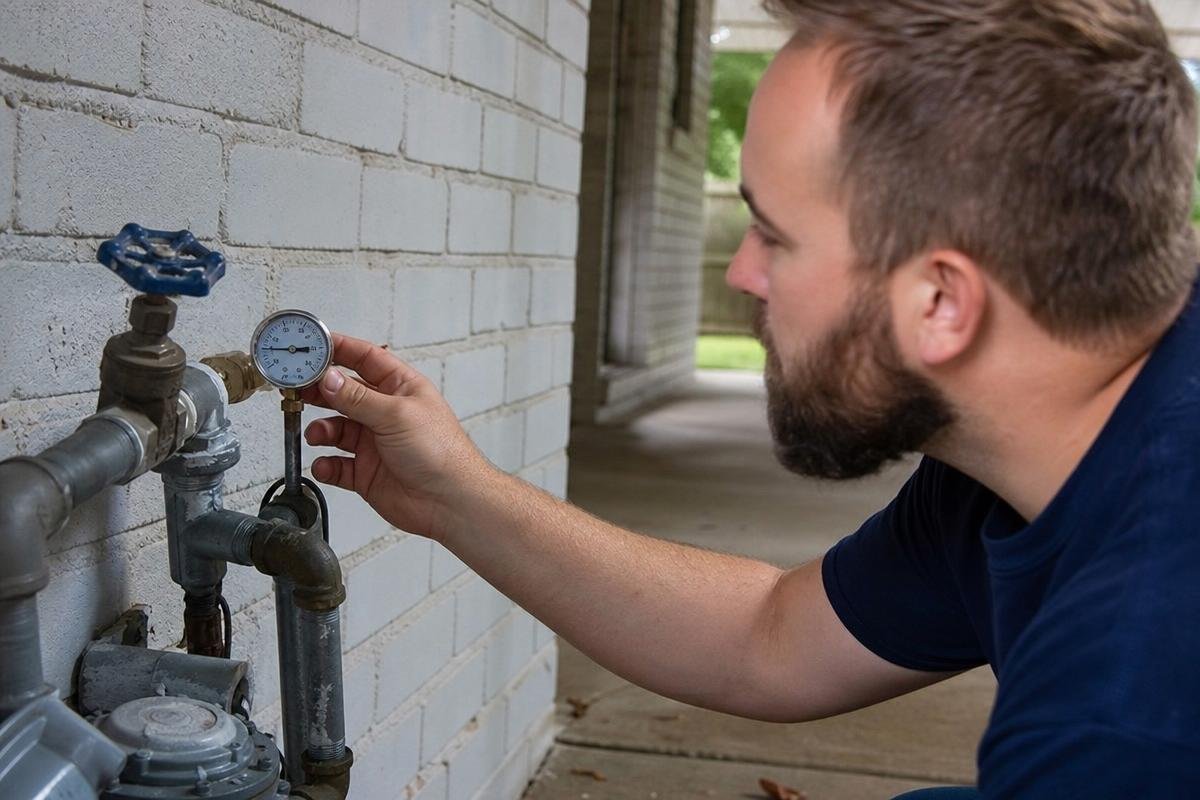
If pressure drops at every faucet in the house at once, a failing pressure regulator valve is the most likely cause. Not just the kitchen. Not just upstairs. Every fixture, same time. That pattern points to one place: the PRV, a bell-shaped brass fitting on your main supply line, factory-set to deliver water between 45 and 80 PSI. When it fails, pressure either tanks below 40 PSI house-wide or sticks open and lets pressure spike past 80 PSI, hammering your fixtures and accelerating wear on every joint in the system.
PRVs have a typical service life of 10 to 15 years. If your home in Stewart Creek Estates was built in the 1980s or 1990s, that regulator is past due. It sits at the supply line entry point, usually near the foundation or utility closet. We trace pressure-related pipe damage back to a failed PRV more often than most homeowners expect.
Test It Yourself Before You Call
- Shut off every fixture in the house.
- Thread a $15 pressure gauge onto the outdoor hose bib closest to the meter.
- Open the bib fully.
- Read the gauge. Below 40 PSI or above 80 PSI means the PRV is the likely culprit.
PRV replacement is a straightforward job for a licensed plumber, typically completed in one to two hours. Contact us for a quote before any work begins. Ignore it for 12 to 24 months and you are looking at fixture damage, joint failures, and pipe wear that costs far more to fix.
Getting an odd gauge reading? Schedule a PRV inspection and we will confirm your house pressure the same day.
Cause 2: Mineral Scale Buildup Inside Your Pipes and Fixtures
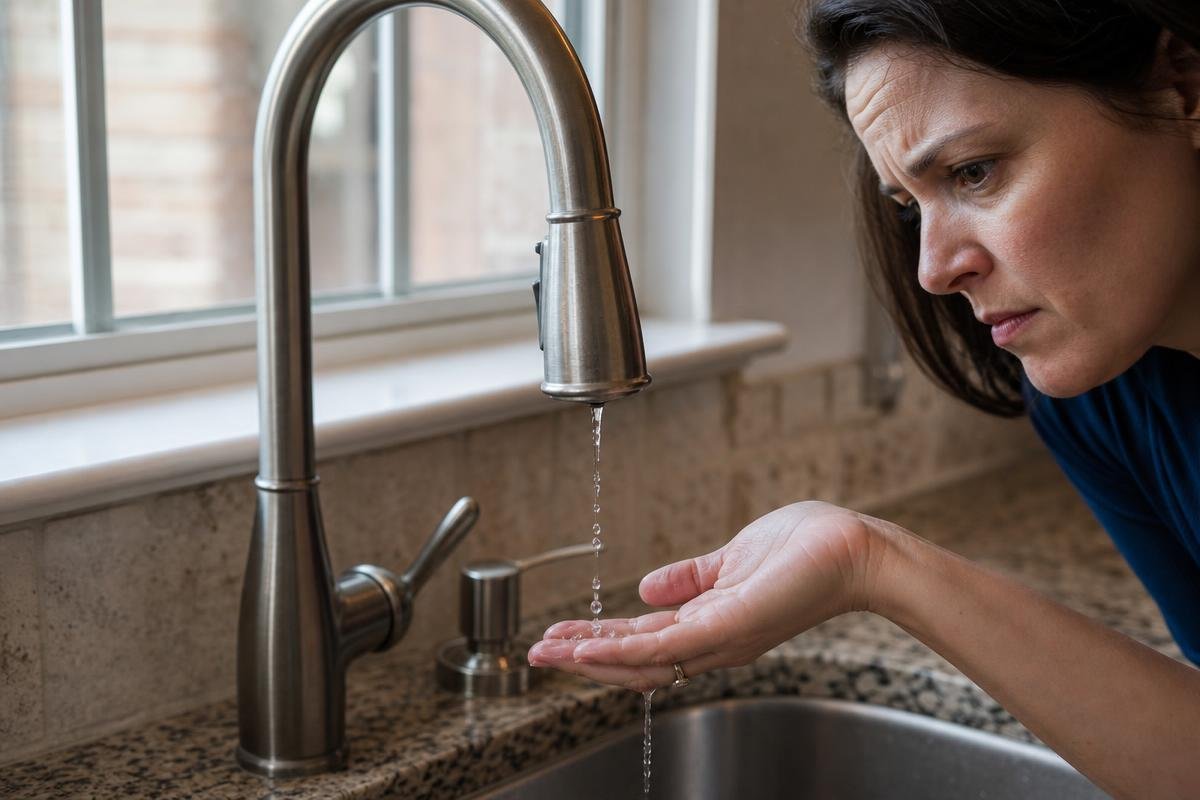
Weak flow at one faucet. Fine pressure everywhere else. That pattern almost always points to mineral scale. NTMWD water runs hard, and calcium carbonate deposits build up fast inside aerators, showerhead screens, and appliance inlet valves. The good news: if scale is only at the fixture, you can fix it yourself this afternoon.
The DIY Fix: Cleaning Aerators and Showerheads
Unscrew the aerator counterclockwise from your faucet tip. If you see a white or tan coating on the screen, that is your culprit. Drop it in a cup of white vinegar for 30 minutes, rinse it clean, and reinstall. Same process works for showerheads: remove, soak, reinstall. If flow improves immediately, scale was blocking that fixture. Do every faucet in the house while you are at it.
When Scale Is Inside the Pipe Itself
If cleaning every aerator helps individual fixtures but overall pressure still feels weak, scale has moved past the fixtures and into your supply piping. As covered in the local conditions section, hard water deposits can cut pipe bore by 30 to 40 percent over time. Galvanized lines found in older properties are the worst offenders because scale bonds to the rough interior surface and does not flush out. That pipe needs replacement, not cleaning.
A whole-home water softener prevents future accumulation after the pipe work is done. Without one, scale returns.
Cause 3: A Partially Closed Shutoff Valve
Whole house has low water pressure. No obvious leak. No scale buildup. Sometimes the answer is embarrassingly simple. A shutoff valve that got bumped, partially closed after a repair, or left at 80 percent after city work on your street can cut flow by 30 to 50 percent. That is why the pressure is low in your house right now, and it costs nothing to fix yourself.
You have two valves to check. First, find your main house shutoff where the supply line enters through the foundation or utility closet. Gate valves have a round wheel handle and must turn counterclockwise until they physically stop. Ball valves have a lever that must sit parallel to the pipe, not perpendicular. Fully open means fully open.
A gate valve that looks open but still has two turns left is strangling your flow. Second, check the meter valve at the curb. If that one is partially closed and you never touched it, contact your local public works or utility directly. It may mean recent city work left it that way.
If you have checked both valves and pressure is still low, our leak detection service can rule out what a valve check cannot. Our team can also verify valve position and full system pressure as part of a diagnostic visit, so you are not guessing twice.
Cause 4: A Hidden Leak Somewhere in Your System
Water bill that jumped $40 last month. Pressure that is soft at every fixture. No obvious drip anywhere. A leak anywhere in your supply system bleeds pressure before water ever reaches your faucet, and a line you cannot see is one of the most common problems we track down.
The Meter Test: Your Best Free Diagnostic Tool
This takes two minutes. Shut every fixture off in the house. Walk to the curb and lift the meter box lid. Look for the small leak indicator dial, usually a triangle or star shape. If it spins with everything off, water is moving somewhere it should not be. Newer neighborhoods often have digital meters that display a flow rate instead of a spinning dial. Any reading above 0.0 with all fixtures off is a leak signal. Call us for professional leak detection before you start pulling drywall.
Slab Leaks and What They Cost If You Wait
Blackland clay heaves seasonally. That movement cracks embedded copper lines under your slab. Hot-side lines fail first because hot water is more corrosive to copper and thermal cycling stresses every joint. We use acoustic listening equipment and thermal imaging to locate the break before any concrete is cut.
Catch it early and an overhead PEX reroute is a manageable repair. Wait six to twelve months and you are looking at a significant bill covering flooring, drywall, and mold remediation. The wrong guess doubles the restoration bill. That is why we locate first and cut second with slab leak repair.
Meter dial spinning with the water off? Get same-day leak detection before the drywall bill starts.
Cause 5: Corroded or Deteriorating Pipes
Brown water first thing in the morning. Metallic taste at the kitchen tap. Pressure that is fine near the meter but weak at the far end of the house. These are the calling cards of corroded pipes, and they are different from the scale buildup we covered in Cause 2. Scale deposits material inside the pipe. Corrosion eats the pipe wall itself.
Galvanized Steel: The Pipe That Looks Fine Until It Isn't
Pre-1985 properties in the area's older subdivisions were often plumbed with galvanized steel. The zinc coating sacrifices first, then the steel rusts from the inside out, leaving a bore choked with rust flakes and corrosion nodules. The outside of the pipe looks intact. The inside is nearly closed off.
Pressure worst at the fixtures farthest from the meter is the clearest sign. Discolored water, especially orange or brown on a cold-water flush, confirms it. Repiping corroded galvanized lines is the only real fix. Patching one section just shifts the problem downstream.
Copper Pitting from Chloramine in The Colony's Water Supply
Yes, NTMWD's chloramine disinfection does damage copper over time. Chloramine is more aggressive on copper interiors than free chlorine, especially in houses with slightly acidic pH or soft water. The result is pitting corrosion: pinhole leaks and progressive pressure loss with no visible scale buildup at all.
A house can have copper lines that look completely clean and still lose pressure year over year. A camera inspection of your supply lines can confirm pipe condition before you commit to a full repipe. If you are seeing pinhole leaks or unexplained wet spots, our leak detection service can pinpoint the damage fast.
Corroded pipes don't fix themselves. Call us and we'll assess your lines before a pinhole becomes a burst.
Cause 6: Clogged or Failing Water Heater Inlet
Hot water pressure weak at every fixture. Cold side runs fine. That pattern points directly at your water heater, not your pipes. Two things cause this: a clogged inlet screen where the cold-water supply line enters the tank, or a partially closed isolation valve on that same supply line. Either one chokes flow before it ever reaches your hot-side line.
Start with the valve. Find the cold-water supply line running into the top or back of your water heater. If it has a gate valve, turn it counterclockwise until it stops. If it has a ball valve, the handle should sit parallel to the pipe. A quarter-turn off is enough to cut pressure noticeably, and it happens more often than you would think after a service call.
If the valve is fully open, the inlet screen is the next suspect. NTMWD water hardness accelerates calcium carbonate scale buildup, and that scale packs the inlet screen fast. Tankless units are worse here because their filter screens are finer. If you have a tankless heater with dropping hot-side pressure, our tankless water heater service includes inlet screen cleaning as a standard step. For tank units, see our water heater service page for what that inspection covers.
Hearing popping or rumbling alongside the pressure drop? That combination usually means sediment is deeper in the tank. Read more in our guide on what water heater noises mean for local homeowners.
Cause 7: Peak-Demand Pressure Drops from Shared Municipal Lines
Pressure fine at noon. Terrible at 7 AM. That pattern points straight to the municipal supply, not your pipes. The Colony's water comes through NTMWD's distribution system, and during peak demand windows, 6 to 8 AM and 5 to 8 PM on weekdays, street-level pressure can drop 10 to 20 PSI across the grid. May through September irrigation season makes it worse, when every yard in the neighborhood runs sprinklers on the same schedule.
How to Tell If the Problem Is the City's or Yours
Run a pressure gauge test at your hose bib twice: once at 2 AM and once at 7 AM on a weekday. A swing of 15 PSI or more between those readings points to municipal demand, not your supply lines. If pressure is consistently low at both times, the problem is inside your property. That is the test that separates a city issue from a pipe issue, and the wrong guess wastes real money.
If public works has been doing water main work on your street recently, also check whether your meter valve got left partially closed. That is covered in Cause 3, and it happens more than people expect after any main repair.
What You Can Do About Municipal Pressure Fluctuations
You cannot fix the city's grid. What you can do is install a booster pump on the main supply line to maintain consistent household pressure regardless of what is happening at street level. This is a licensed plumber installation, not a weekend project. If pressure problems in your area keep coming back, ask us about professional leak detection first to rule out a property-side cause before investing in a booster.
Cause 8: Slow Drains Mistaken for Low Water Pressure
Water pooling around your feet in the shower. A sink that fills up before you finish rinsing. These feel like weak pressure, but they are not. Supply pressure is how hard water comes out of the faucet. Drain performance is how fast water leaves. Those are two completely different systems.
If the water pressure is fine but the tub drains like a swamp, you have a drain problem, not a pressure problem.
Older vented drain systems in properties built in the late 1970s through early 1990s are especially prone to this mix-up. A partial clog in a branch drain line can create back-pressure in the vent stack, which makes the fixture feel sluggish at both ends. Homes of similar vintage across the area report the same confusion.
The fix is clearing the obstruction, not chasing your supply lines. Hydro jetting blasts through grease and debris that a snake leaves behind, and our same-day drain cleaning service gets it handled fast. For a full breakdown of your options, read our guide on whether to DIY or hire a pro for a clogged drain.
Low Water Pressure Diagnostic Checklist for The Colony Homeowners

Eight quick checks. Run through these before you call anyone. Most weak-pressure problems in The Colony, TX trace back to something on this list, whether you are in a late-1980s build near the Windhaven area or a newer home closer to Lewisville Lake.
- Check both shutoff valves. The one at the meter and the one where the main line enters your house. Both need to be fully open, handle parallel to the pipe.
- Test pressure at the hose bib with a gauge. Under 40 PSI with every fixture off? You have a real pressure problem, not just a slow faucet.
- Pull and inspect one aerator. White, chalky coating means NTMWD hard water scale is choking your flow at the fixture level.
- Run the meter leak test. Shut every fixture off. Watch the small dial on your meter. Spinning? You likely have a hidden leak pulling pressure down.
- Compare hot side versus cold. Pressure weak only on the hot-side line? The water heater inlet screen or a failing unit is the target.
- Note the time of day. Pressure fine at 2 AM but weak at 7 AM? That points to peak-demand drops on shared municipal lines, not your pipes.
- Check for discolored water. Brown or orange tint at the tap means corroded galvanized pipe is shedding rust and narrowing your flow.
- Confirm the issue is pressure, not drainage. Water pooling in the shower or a sink that fills before draining is a drain issue. Test supply pressure with a gauge before chasing your supply lines.
If you work through all eight and still cannot pin it down, or that meter dial will not stop spinning, call our team. Devan and the crew are available seven days a week and have built a strong record of five-star Google reviews diagnosing exactly these water pressure problems. Our plumbing FAQ page has additional diagnostic guidance if you want to keep digging before you call.
Still stumped after the checklist? Call us and we'll sort it out the same day.
Aqua Pure Plumbing Serves The Colony and Nearby Cities
We handle plumbing calls across The Colony and the surrounding DFW communities. If you're nearby, we can get to you fast.
- Flower Mound
- Lewisville
- Allen
- Farmers Branch
- Addison
- Coppell
- Frisco
- McKinney
- Plano
- Carrollton
- Lake Dallas
- Richardson
- Highland Village
Frequently Asked Questions
What is the most common cause of low water pressure in The Colony homes?
Mineral scale from NTMWD's hard water and partially closed shutoff valves are the two most frequent culprits we find. Scale chokes aerators, inlet screens, and pipe interiors gradually, so pressure drops slowly enough that many homeowners don't notice until flow is noticeably weak.
How do I know if my pressure regulator has failed?
Pick up a $15 pressure gauge at any hardware store and thread it onto an outdoor hose bib. Below 40 PSI with every fixture off, or above 80 PSI, both point to pressure regulator failure. That test takes five minutes and gives you a real number before anyone touches a wrench.
Can a slab leak cause low water pressure throughout the house?
Yes. A slab leak bleeds supply pressure before water ever reaches your fixtures. Shut every fixture off and watch the meter dial. If it's still spinning, you likely have a leak. Catching it early means an overhead PEX reroute at a manageable cost. Left six to twelve months, remediation costs can escalate significantly.
Why is only my hot water pressure low, not the cold?
A clogged inlet screen, a failing dip tube, or a partially closed isolation valve on your water heater is almost always the cause. The cold-side line stays unaffected because the restriction is on the hot side only.
Is low water pressure always a sign of a leak?
Not always, but consistently low pressure combined with a spinning meter dial is a strong indicator. A slow drip may not drop pressure noticeably, but pressure loss paired with a higher-than-normal water bill warrants professional leak detection before the problem gets worse.
How much does it cost to fix low water pressure in The Colony?
PRV replacement is a straightforward repair. Pricing depends on your setup. Cleaning an aerator costs nothing if you do it yourself. A slab leak reroute caught early stays manageable. Full repiping varies by scope. We diagnose the cause first, then give you a straight quote before any work starts.
Run through the checklist above. If the meter dial is spinning, pressure reads below 40 PSI with everything shut off, or you have discolored water with no clear answer, call us. Aqua Pure Plumbing is based in The Colony and serves homeowners across the area seven days a week.
Need a licensed plumber in The Colony?
We answer 7 days a week, 8 AM to 6 PM, with same-day service across The Colony and 13 nearby DFW cities.